


The healthcare sector is changing fast. In the past decade, artificial intelligence (AI), machine learning, and new healthcare technologies have started to reshape how healthcare professionals and medical professionals work and how patients experience care. Today, designing for healthcare isn’t just about making things look good. It’s about creating healthcare UX that truly supports patient care and improves patient outcomes.
Across healthcare systems, from small medical practices to large healthcare organizations, teams are adopting digital health solutions like electronic health records, patient portals, and medical devices. These tools help reduce administrative burdens, give clinicians better access to healthcare data and support clinical workflows, all while keeping patient safety and care quality at the center.
For UX designers, this is an exciting moment. With AI models, deep learning, and cutting-edge technology, we can create patient-centered experiences that not only make healthcare delivery more efficient but also make patients feel heard, supported, and understood. By blending thoughtful UX design in medical applications with AI-driven insights, healthcare providers can navigate significant challenges, optimize operational efficiency, and help improve patient outcomes.
In this article, we’ll explore the emerging trends in healthcare UX, showing how AI adoption and healthcare innovation are transforming patient care and enabling precision medicine, smarter diagnostic accuracy, and a better overall patient experience.
The rising importance of healthcare UX
Good UX design in medical applications isn’t just a nice-to-have. It’s essential for modern healthcare systems. Thoughtful healthcare UX supports healthcare professionals and medical professionals in navigating complex health records, electronic health records, medical devices, and digital health solutions while improving patient outcomes and overall patient care.
Key UX impact facts in healthcare
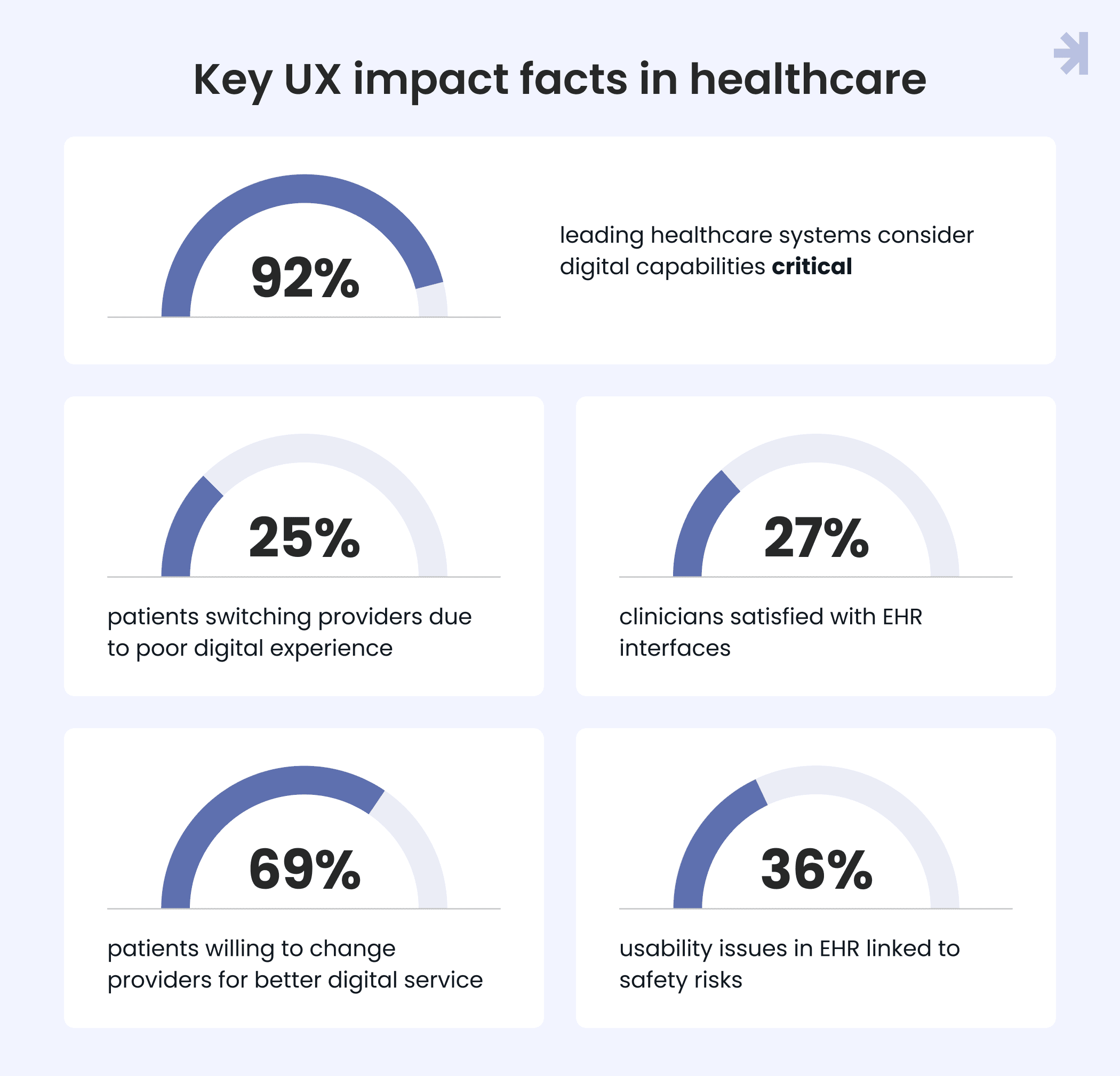
- 92% of leading healthcare systems report that digital capabilities, including UX, are critical to improving patient engagement and satisfaction.
- Over 25% of patients have switched providers due to a poor digital experience.
- 69% of patients are willing to change providers for better digital service and healthcare applications. AI applications in healthcare include drug discovery, virtual clinical consultation, disease diagnosis, prognosis, medication management, and health monitoring.
- Only ~27% of clinicians report being highly satisfied with EHR interfaces, linking poor UX to increased administrative burdens.
- 36% of usability issues in EHRs have been associated with risks to safety and health outcomes.
- Effective UX design reduces errors, streamlines clinical workflows, and increases operational efficiency across healthcare systems.
- Organizations investing in healthcare UX design see significant ROI, due to fewer mistakes, better staff productivity, and improved patient engagement.
What these facts mean in practice
When UX designers create patient-centered experiences for both healthcare providers and patients:
- Clinicians navigate health records and electronic health records more efficiently.
- Patients engage more actively with digital health solutions and patient portals.
- Administrative errors decrease, improving clinician workflows and medical care.
- Overall, healthcare UX becomes a tool to enhance patient outcomes, streamline workflows, and make healthcare delivery smoother and more human-centric.
AI models and machine learning in healthcare UX
As the healthcare sector undergoes rapid transformation, artificial intelligence and deep learning have shifted from buzzwords to core components shaping how clinicians and patients interact with digital systems. For UX designers working in healthcare, understanding how AI models and machine learning integrate with healthcare technologies is now a vital part of designing intuitive, effective experiences that support clinical practice, enhance medical care, and improve outcomes across health systems.
In modern digital experiences, AI isn’t just a backend feature. It influences how people see, use, and trust interfaces. From smart suggestions in electronic workflows to medical imaging interpretation and personalized insights based on medical data, AI has started to reshape the way patients and providers engage with technology.
By combining thoughtful UX design medical interfaces with AI tools and cutting edge technology, healthcare products can help clinicians access insights faster, make sense of complex health data, and reduce inefficiencies in everyday tasks, supporting high‑quality care rooted in real human needs.
How AI and machine learning improve healthcare UX
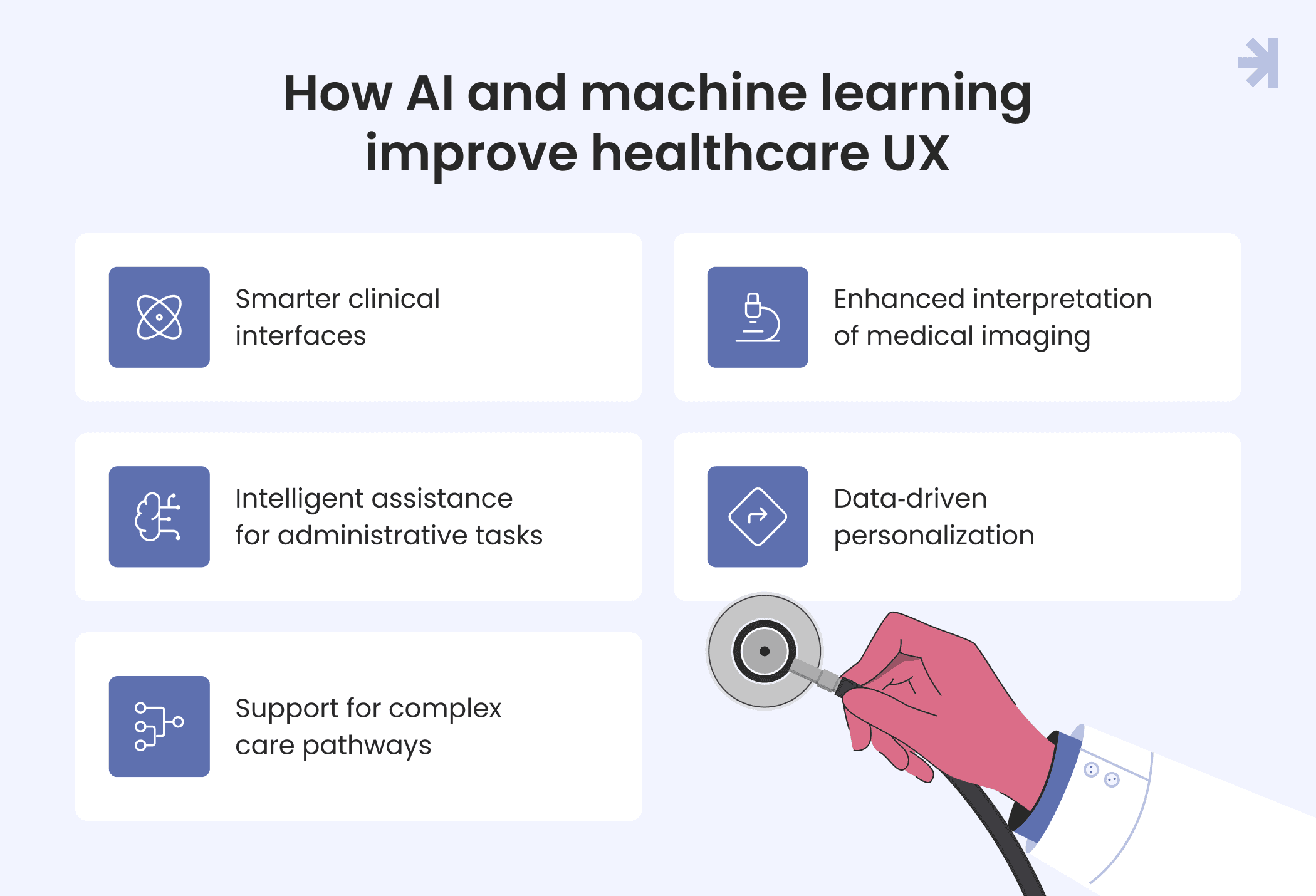
- Smarter clinical interfaces: AI‑driven interfaces can adapt in real‑time, showing the most relevant medical data when clinicians need it most. This reduces cognitive overload and improves flow during clinical practice.
- Enhanced interpretation of medical imaging: AI algorithms assist with image analysis, helping clinicians spot patterns quickly and reducing the time required for diagnosis, which strengthens trust in the interface and supports better decision‑making.
- Intelligent assistance for administrative tasks: AI tools that automate routine work (such as scheduling, documentation suggestions, and speech recognition) free up time for clinicians and administrative teams, leading to more efficient patient engagement.
- Data‑driven personalization: Machine learning can identify patterns in patient data that help healthcare systems tailor experiences, from reminders to educational content, making care feel more personal and human.
- Support for complex care pathways: Whether it’s insight into disease progression or assistance in treatment planning, AI helps clinicians interpret layers of health data without overwhelming them, smoothing workflows and improving clarity.
Addressing the challenges
Despite its promise, integrating AI models into healthcare UX comes with significant challenges. Designing interfaces that remain transparent, secure, and trustworthy is essential especially when they influence real decisions about medical care. The use of AI in healthcare raises ethical considerations such as data privacy, security, equity, and safety. UX designers must work alongside clinicians, developers, and human experts to make sure AI enhances user experience without obscuring it.
AI systems can analyze vast amounts of clinical data quickly, helping professionals identify disease markers, patient risks, and population health trends. AI systems must be continually monitored and maintained to ensure safety and effectiveness after deployment in clinical settings.
It’s not just about adding “smart features”. It’s about ensuring that these systems integrate into workflows in ways that feel intuitive and supportive. Healthcare organizations face challenges in integrating AI systems into existing workflows, such as electronic health records, while also training staff and ensuring clinician acceptance. When done well, AI‑enhanced experiences help reduce errors, streamline processes, and empower users to engage with technology confidently.
Key emerging trends in healthcare UX
The healthcare sector is evolving rapidly, and healthcare continues to integrate artificial intelligence (AI), medical devices, and AI tools to improve health systems and medical care. As UX designers work in this space, understanding these emerging trends is essential for designing experiences that meet the needs of patients, clinicians, and regulatory bodies alike.
Designing for medical applications involves minimizing user error in high-stakes scenarios through clear prompts and validation. Best practices in UX design for medical applications focus on reducing cognitive load, maximizing accessibility, and fostering trust through intuitive interfaces. UX design for medical applications requires a specialized, safety-first approach that balances complex data and strict regulatory compliance.
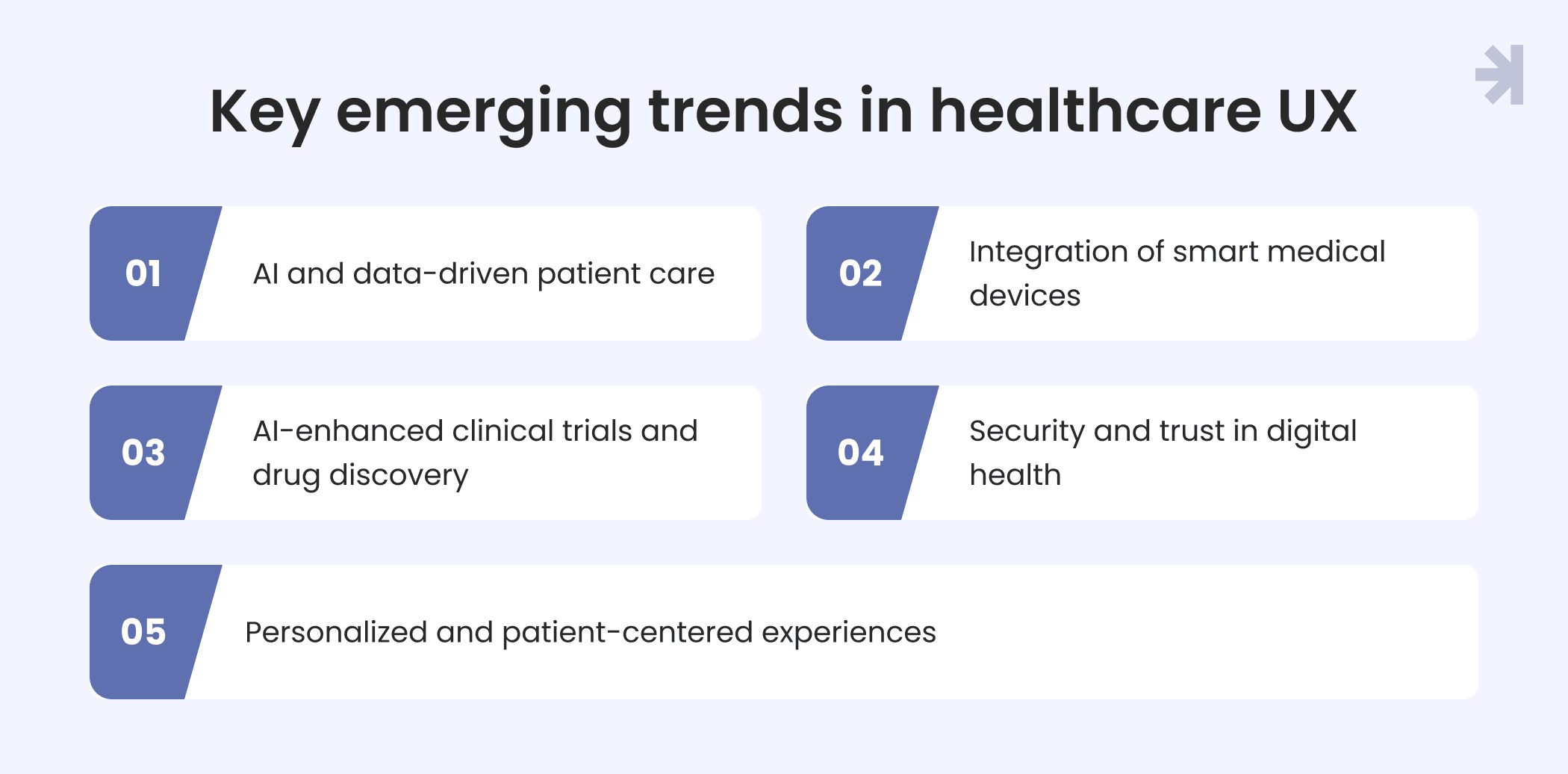
1. AI and data-driven patient care
- AI systems and data-driven insights are helping clinicians make faster, more accurate disease diagnosis decisions. Workflows in medical applications should be streamlined to allow users to complete tasks in three clicks or less.
- From kidney disease monitoring to personalized treatment plans, healthcare UX design now incorporates predictive analytics that support medical care and better patient outcomes.
2. Integration of smart medical devices
- Connected medical devices allow patients and providers to monitor health continuously.
- UX designers focus on creating intuitive interfaces so data from devices is actionable for both patients and clinicians. Intuitive patient portals enhance engagement through personalized access to appointment management and health records.
- Seamless integration across health systems reduces errors and improves workflow efficiency.
3. AI-enhanced clinical trials and drug discovery
- Clinical trial design and drug discovery are increasingly supported by AI tools. AI can detect the presence of certain diseases before the patient is even aware of any symptoms.
- UX designers play a role in creating dashboards and platforms that make complex trial data understandable for researchers and clinicians, helping healthcare organizations act on insights quickly. Simplifying complex information with plain language and visual aids enhances patient understanding of medical instructions.
4. Security and trust in digital health
- As AI systems and medical devices collect more health data, data security and compliance requirements remain critical. Privacy by Design principles require compliance with regulations like HIPAA and GDPR incorporated directly into the application design. Accessibility in design includes ensuring high contrast, readable fonts, and screen reader support according to WCAG 2.2 AA standards.
- Thoughtful UX design ensures that both patients and clinicians trust the technology without being overwhelmed by complexity. The visual tone of medical applications should remain calm and professional to manage user anxiety effectively.
5. Personalized and patient-centered experiences
- Making healthcare more accessible through AI tools and data-driven personalization is gaining momentum. High-quality UX in medical applications allows patients to easily book appointments, access records, and manage billing.
- The healthcare sector faces unique challenges due to the complexity of medical data and the diverse needs of its users. From patient portals to connected devices, personalized interfaces increase engagement and support clinicians in providing quality care.
AI features in healthcare products fail more often from design decisions than from technical ones. The model works. The interface doesn't. Getting AI-driven UX right in a healthcare context requires a specific set of conditions, most of which need to be established before a single screen is designed.
1. Role-specific research before any AI feature is scoped
Different users have fundamentally different relationships with AI assistance. A doctor using AI-suggested documentation needs to stay in control of clinical judgment. A nurse using AI to build forms needs reliability and predictability over sophistication. A patient interacting with an AI-powered symptom checker needs reassurance over efficiency. Designing one AI interaction model and applying it across all three roles is one of the most common and costly mistakes in healthcare product design. Research that maps how each role thinks about AI, not just what they need from the product, has to come first.
2. Transparency standards for how AI outputs are presented
Users in healthcare need to understand what an AI output means, how confident the system is, and what they should do with it. This isn't optional in a clinical context. It's the difference between a feature that gets used and one that gets ignored. Designing for transparency means deciding upfront: when does the system show confidence levels? How does it communicate uncertainty? What happens when the AI produces a result that contradicts a clinician's prior assessment? These questions need design answers, not engineering ones.
3. Fallback UX for when the AI is wrong or uncertain
Most AI product UX is designed for the happy path, when the model performs well. Very little attention goes to what happens when it doesn't. In healthcare, low-confidence results, unexpected outputs, and outright errors are not edge cases. They are regular occurrences that the interface needs to handle gracefully. Error states, fallback experiences, and clear ways to override or correct AI outputs are not afterthoughts. They are core UX deliverables that need as much design attention as the primary flow.
4. Accessibility requirements specific to AI interfaces
AI-generated content introduces accessibility challenges that static interfaces don't have. Dynamically updated content needs to be announced correctly to screen readers. Confidence indicators and visual cues need text equivalents. Complex AI outputs presented as charts or visualizations need accessible alternatives. In healthcare, where users include older patients, people with visual impairments, and clinical staff working under time pressure, accessibility isn't a compliance checkbox. It's a functional requirement that shapes whether the AI feature works for the people who need it most.
5. A trust-building period built into the UX
Users don't trust AI features immediately, especially in high-stakes healthcare contexts where the cost of a wrong decision is real. Good AI-driven healthcare UX accounts for this explicitly. That might mean starting with AI suggestions that are clearly advisory rather than directive, providing easy ways for users to see why the AI produced a particular output, or designing onboarding that helps users develop an accurate mental model of what the AI does and doesn't do well. Trust built through good UX design compounds over time. Trust lost in the first session rarely recovers.
Final thoughts
None of this works without strong design. UX designers are essential in shaping how artificial intelligence shows up in healthcare, making sure systems feel supportive, transparent, and trustworthy. When design leads the way, AI becomes a quiet assistant rather than a confusing black box.
Healthcare stands at a turning point. AI is no longer optional, but its success depends on how thoughtfully it’s applied. AI-driven UX helps healthcare move forward with confidence, addressing real problems, supporting real people, and building systems that can adapt as needs continue to change.
Design your healthcare product with MagicFlux
Healthcare products are complex. Users are under pressure. And the cost of poor design is real. That’s where MagicFlux comes in.
We help healthcare teams design digital products that are clear, human, and built for real-world use. From AI-powered platforms to clinician tools and patient-facing experiences, we focus on UX that supports people, not just technology.
Our approach combines deep healthcare understanding with thoughtful design. We work closely with your team to turn complex systems into intuitive experiences that scale with your product and adapt as healthcare continues to evolve.
If you’re building or improving a healthcare product and want design that truly supports users, we’d love to help.
Let’s design something that works in the real world.

1. How is AI helping in the healthcare industry?
AI is transforming the healthcare sector by analyzing medical data, supporting disease diagnosis, optimizing clinical workflows, and improving patient care. From predictive analytics to smart medical devices, AI allows healthcare providers to make faster, data-driven decisions while enhancing the overall patient experience.
2. How to use AI in healthcare?
Healthcare organizations use AI through AI systems, medical devices, and digital health solutions. AI can help clinicians interpret medical imaging, personalize treatment plans, monitor patient data, and streamline administrative tasks. The key is thoughtful UX design, making sure AI integrates seamlessly into daily practice.
3. How do AI tools improve patient outcomes?
AI tools analyze health data to identify patterns and predict risks, helping clinicians provide more precise care. When paired with thoughtful UX design, these tools improve communication, personalize medical care, and support better health outcomes.
4. Can AI reduce costs in healthcare?
Yes. AI-driven healthcare technologies can reduce administrative burdens, streamline workflows, and optimize resource use. Thoughtful UX design ensures that these cost savings do not compromise high-quality care.
5. What are the main challenges of integrating AI in healthcare?
Integrating AI comes with unique challenges, such as maintaining data security, ensuring accuracy, and designing interfaces that clinicians trust. Effective UX design addresses these challenges by making AI tools transparent, intuitive, and supportive rather than overwhelming.