



Patient engagement is no longer just a “nice to have” in the healthcare sector. It directly impacts outcomes, treatment adherence, and overall healthcare experience.
Today, healthcare companies invest heavily in digital health solutions, from patient portals to telemedicine platforms and disease management apps. But many of these healthcare products still struggle with low engagement. Users drop off, ignore key features, or fail to complete critical actions.
The reason is rarely functionality. It’s a poor healthcare UX design.
Complex healthcare systems, overloaded user interfaces, and unclear flows create friction for both patients and healthcare professionals. In high-stakes healthcare settings, even small usability issues can lead to confusion, errors, or missed actions.
That’s why UX in healthcare must go beyond aesthetics. It requires deep UX research, understanding of medical data, and the ability to design for diverse users with very different needs.
In this case study, we show how a strategic UX design approach, grounded in user-centered design, usability testing, and clear data visualization, helped improve patient engagement by 30% and deliver better digital experiences.
The challenge: Low engagement in a complex healthcare product
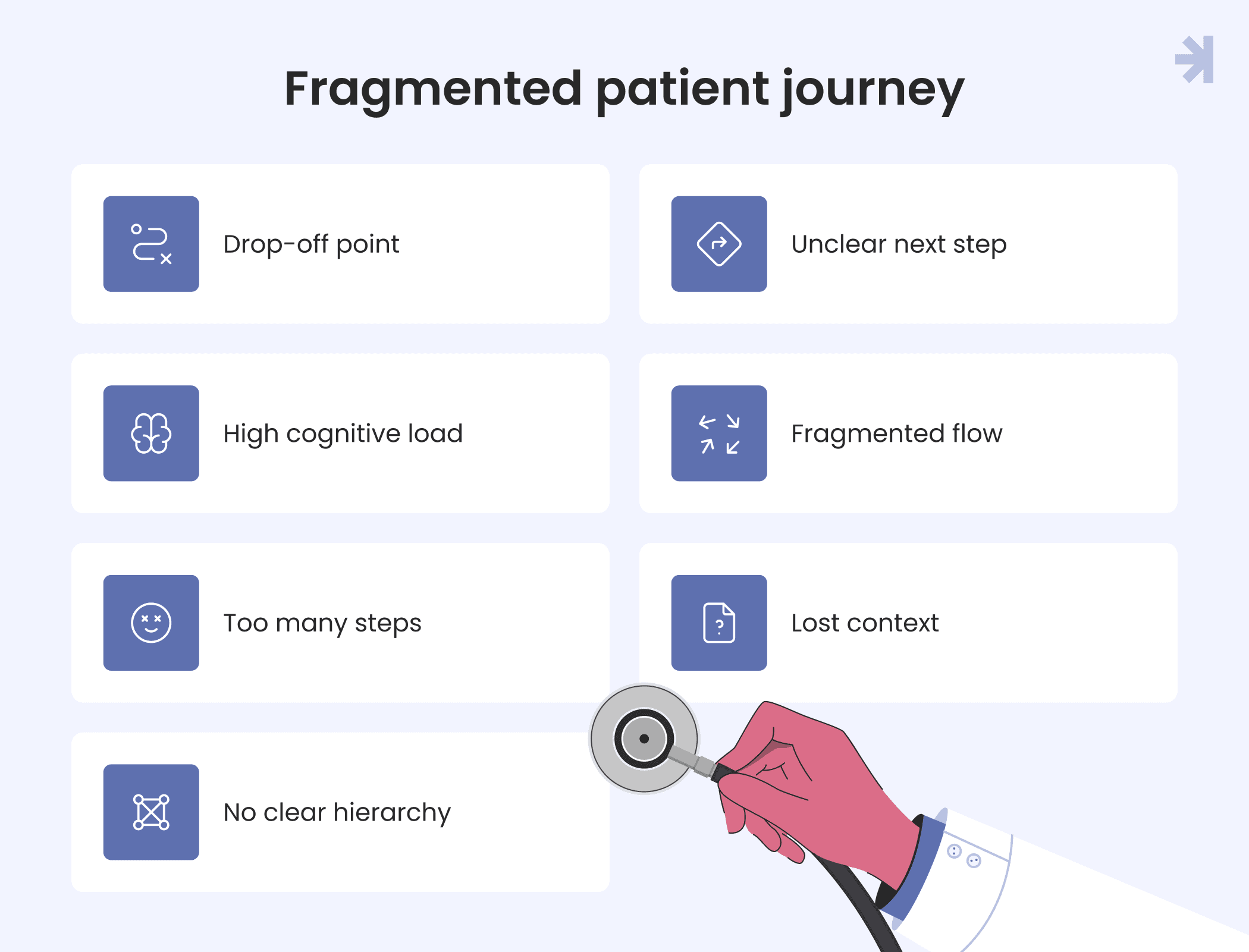
The healthcare product we worked on operated in a highly complex healthcare system, serving both patients and healthcare providers within a regulated healthcare industry environment. Despite strong technical foundations and advanced healthcare technology, the product was underperforming in one critical area – patient engagement.
Users were not completing key actions inside the patient portal, and many were dropping off early in their journey. This directly affected patient care, treatment follow-ups, and overall healthcare experience across the platform.
The main issue was not the lack of functionality, but the way it was presented. The interface was overloaded with medical terminology, complex flows, and fragmented user interfaces, making it difficult for non-technical users to navigate. Even healthcare professionals reported friction when trying to support patients through the system.
From a UX in healthcare perspective, the product lacked clarity, structure, and proper information architecture. Critical workflows like appointment tracking, medical diagnostics access, and patient monitoring were buried under multiple layers of interaction.
Initial UX research and usability testing revealed several core problems:
- Users struggled to understand the next steps due to unclear medical jargon
- Poor data visualization made medical information hard to interpret
- The system did not adapt to the different user needs across diverse users
- Limited guidance reduced trust in the platform, especially in sensitive healthcare settings
Additionally, there was no consistent design approach across different modules of the product. This led to a fragmented experience across electronic health records (EHR systems) and appointment flows.
In short, the product was functional, but not usable in a real-world healthcare space, where clarity, speed, and trust directly impact outcomes.
This gap between functionality and usability became the key focus of the redesign.
UX audit and research: Uncovering the real problems
We started with a focused UX audit and deep UX research to understand how the product performs across different user needs.
The research process included:
- Cross-functional design team from a creative agency with expertise in healthcare UX design, healthcare tech, and complex healthcare products
- User testing with real scenarios from patient care
- Analysis of medical data flows across clinical and non-clinical journeys
- Review of past research and benchmarks in the healthcare industry and healthcare innovation
- Focus on data security and compliance with the Health Insurance Portability and Accountability Act
We also mapped core workflows in UX design, including:
- Patient journeys in patient monitoring and medical diagnostics
- Interaction patterns used by healthcare providers and medical staff
- Role of data visualization and design systems in complex decision-making
- How intuitive interfaces support faster actions in critical workflows
Additional research covered:
- Evolution of healthcare technology and digital transformation in healthcare
- Adoption of AI integration and AI powered diagnostics in modern systems
- Expectations for patient experience in modern healthcare solutions
- Differences in behavior across diverse users in healthcare settings
This helped us build a clear foundation for the next phase of the project and align the redesign with real-world UX in healthcare standards.
Key UX issues that reduced patient engagement
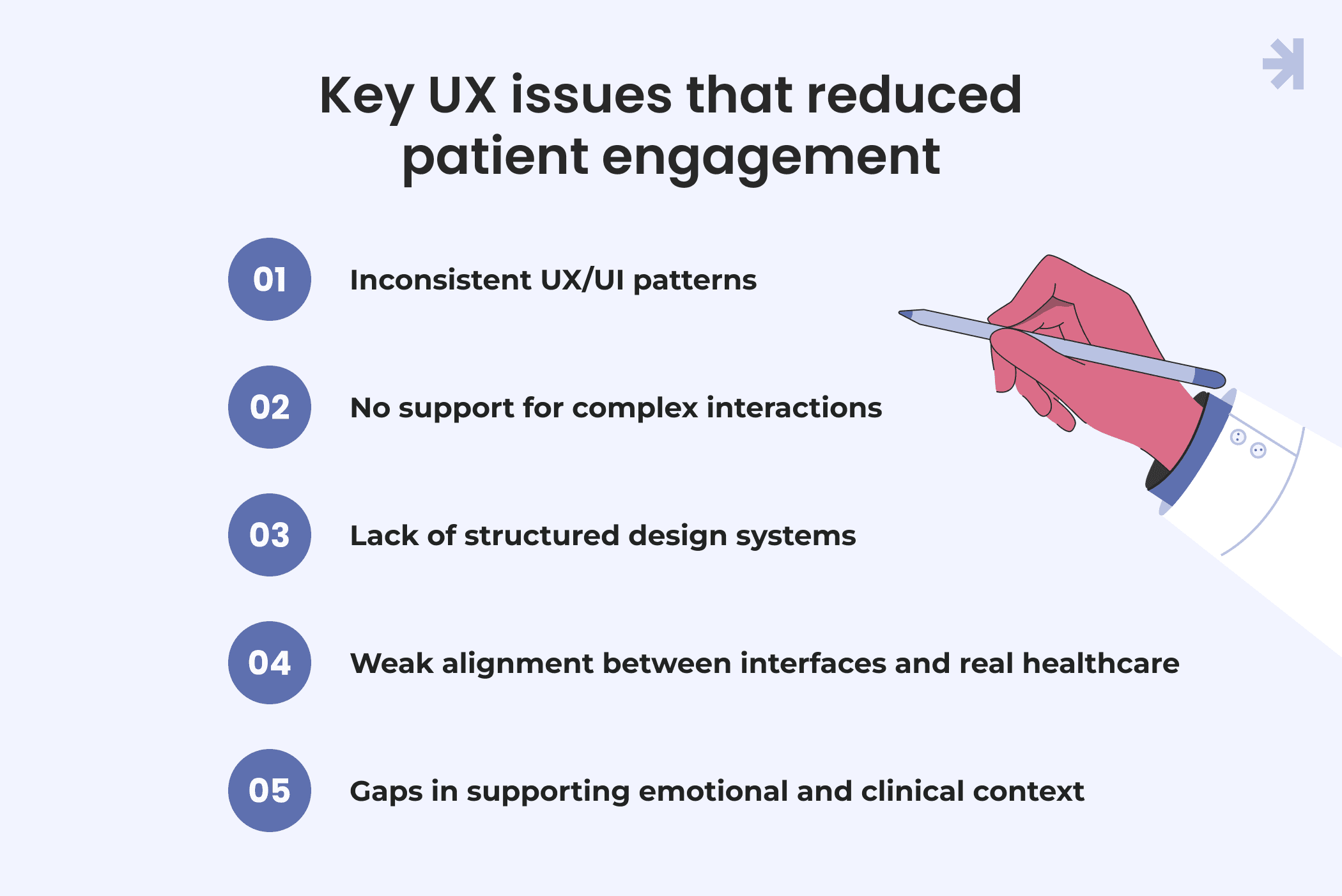
The findings from design research and deep research revealed several specific challenges that directly impacted patient engagement and overall patient experience inside a complex healthcare system.
From a healthcare UX design perspective, the product did not fully reflect real user needs in everyday medical care, especially in high-pressure environments involving patient data and data security.
Key UX issues included:
- Inconsistent UX/UI patterns across core flows reduced clarity for both healthcare providers and UX designers
- The UX design approach did not fully support complex interactions tied to medical devices and telehealth services
- Lack of structured design systems created friction in scaling healthcare products across different design projects
- Weak alignment between interface logic and real-world healthcare UX scenarios limited usability in critical moments
- Gaps in supporting emotional and clinical context, especially in mental health related journeys
From a broader healthcare UX designer perspective, the system struggled to translate complex systems into a truly human centered user experience. Even with access to cutting edge technology, including artificial intelligence, augmented reality, and experimental virtual reality, the experience remained fragmented.
We also observed that while healthcare technology and emerging trends were considered in the product vision, they were not consistently reflected in everyday interactions or web design patterns. In practice, this created a gap between advanced capabilities and real user experience, making it harder to support modern expectations in healthcare.
For healthcare designers, this highlighted a clear mismatch between system complexity and the level of simplicity required to truly improve patient outcomes.
UX solutions: How we redesigned the experience
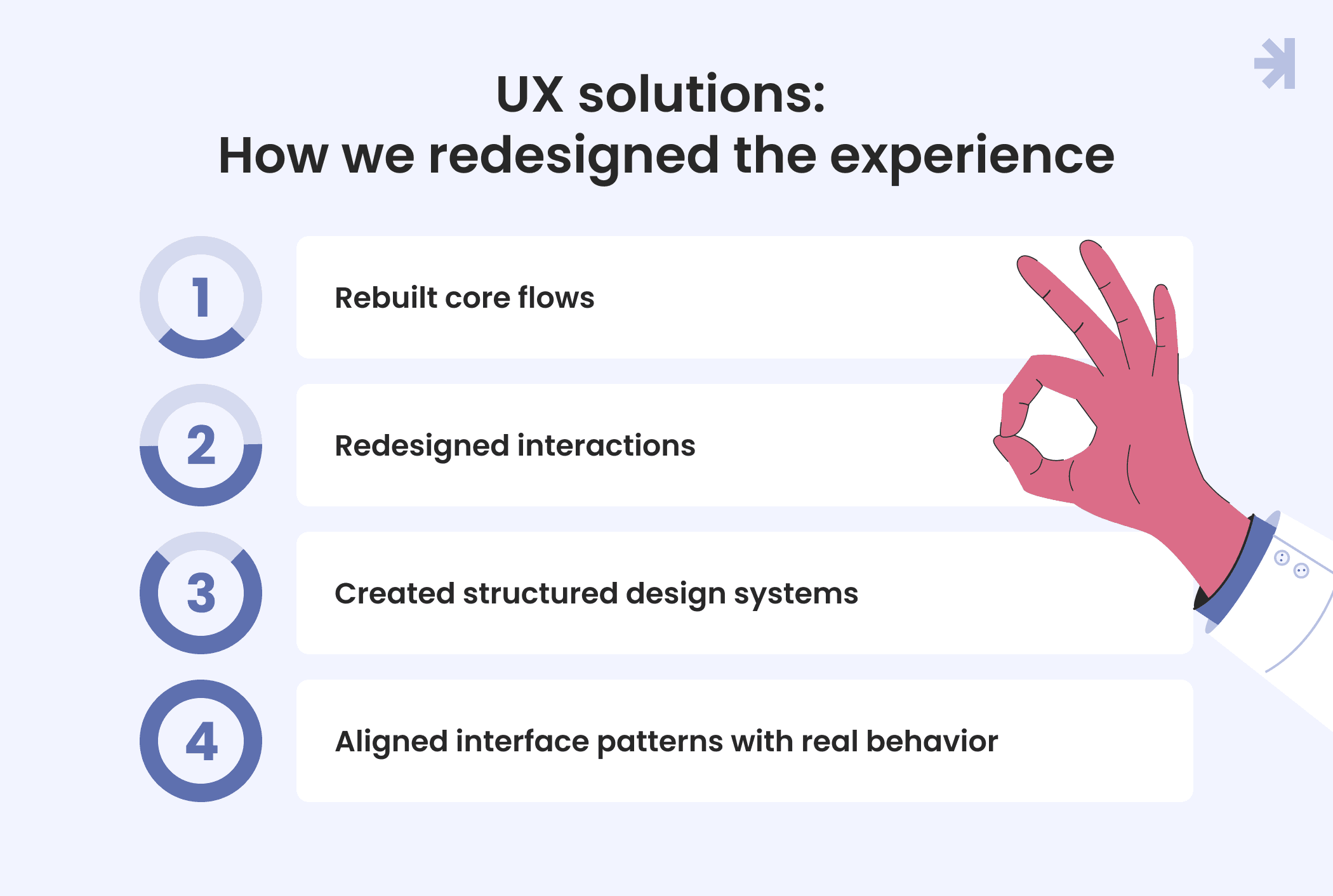
The redesign started with a clear shift in healthcare UX design thinking from complex feature stacks to a focused UX design approach built around real user needs and a stronger patient experience.
Working as a team of UX designers, we reworked the product to simplify the UX/UI layer without losing clinical depth.
Key solutions included:
- Rebuilding core flows to improve patient engagement through clearer, goal-driven journeys
- Redesigning interactions around medical devices to make complex data easier to understand
- Creating structured design systems to unify experience across all healthcare modules
- Aligning interface patterns with real-world user experience behavior from research
We also applied validated research methods to continuously test assumptions and refine solutions. Each iteration was checked against real user needs, ensuring the redesign addressed the actual unique challenges found in the system.
The result is a more focused healthcare UX design approach – one that reduces friction, supports real workflows, and improves overall patient experience without adding unnecessary complexity.
The impact: +30% patient engagement through better UX
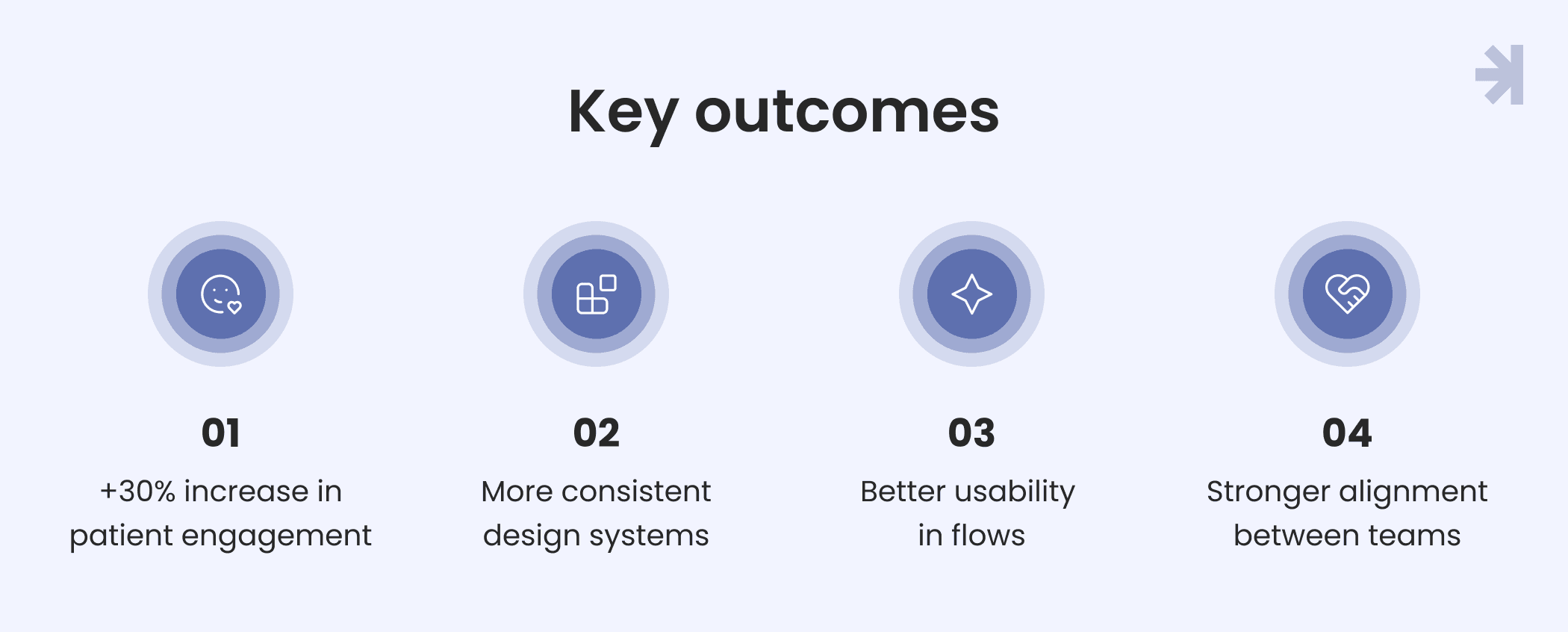
The redesign delivered a clear shift in how users interact with the product. Patient engagement increased by 30%, driven by a more focused healthcare UX design approach and a simplified UX design structure built around real user needs.
Instead of adding more features, we reduced friction. The experience became more direct, more predictable, and easier to navigate across complex healthcare workflows.
Key outcomes included:
- +30% increase in patient engagement across core journeys
- More consistent design systems, improving overall user experience
- Better usability in flows involving medical devices, especially in high-focus scenarios
- Stronger alignment between ux designers and healthcare UX designer decisions
We also saw improved clarity in how users interact with the system. When the structure reflects real user needs, even complex healthcare environments become easier to manage.
While healthcare continues to evolve with technologies like artificial intelligence and experimental virtual reality, the biggest impact came from refining fundamentals – clear UX design, strong structure, and a human-centered user experience that actually supports real behavior.
UX principles that made the difference
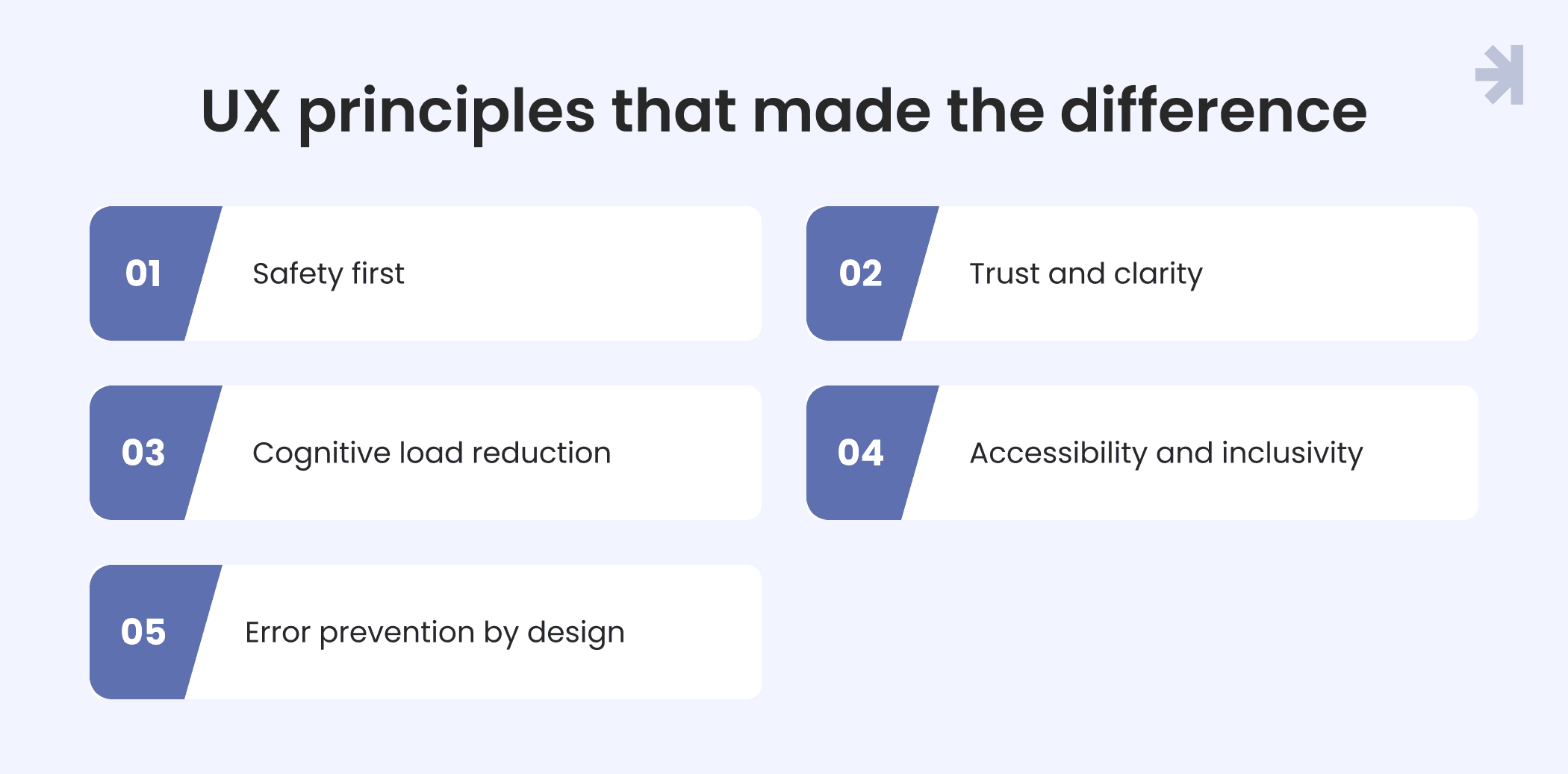
In healthcare, UX design is not about interfaces. It’s about shaping safe and reliable touchpoints between patients, clinicians, and systems. Every interaction influences real-world outcomes, so strong healthcare UX design directly supports better patient care and overall system efficiency.
The principles we applied were built around real constraints of the healthcare sector:
- Safety first – interfaces must prevent errors in high-stakes workflows, especially in EHR systems and clinical actions
- Trust and clarity – users must feel confident when interacting with sensitive patient data and medical data
- Cognitive load reduction – complex healthcare systems should expose only what is needed, when it is needed
- Accessibility and inclusivity – design must support users with different abilities following strict accessibility standards
- Error prevention by design – real-time validation, clear feedback, and safe undo actions for critical flows
We also design for real human conditions. In healthcare settings, users are often stressed, in pain, or under time pressure. That’s why UX designers focus on calm visual structure, clear hierarchy, and minimal steps, especially in patient-facing flows like patient portals and telehealth services.
Another core principle is separation of contexts. Healthcare UX must balance different needs across:
- patients
- clinicians
- administrative staff
Each group requires different flows, priorities, and levels of detail within the same healthcare system. Modern healthcare continues to evolve, especially after the acceleration of digital adoption driven by the pandemic. This increased demand for scalable healthcare solutions and better patient experience across digital channels.
Finally, compliance and privacy remain fundamental. Healthcare products operate under strict regulations, where data security, HIPAA requirements, and ethical handling of patient data are not optional. They are part of the design itself.
These principles define what effective UX design in healthcare really means: clarity, safety, and human-centered thinking at every step.
Lessons for healthcare product teams
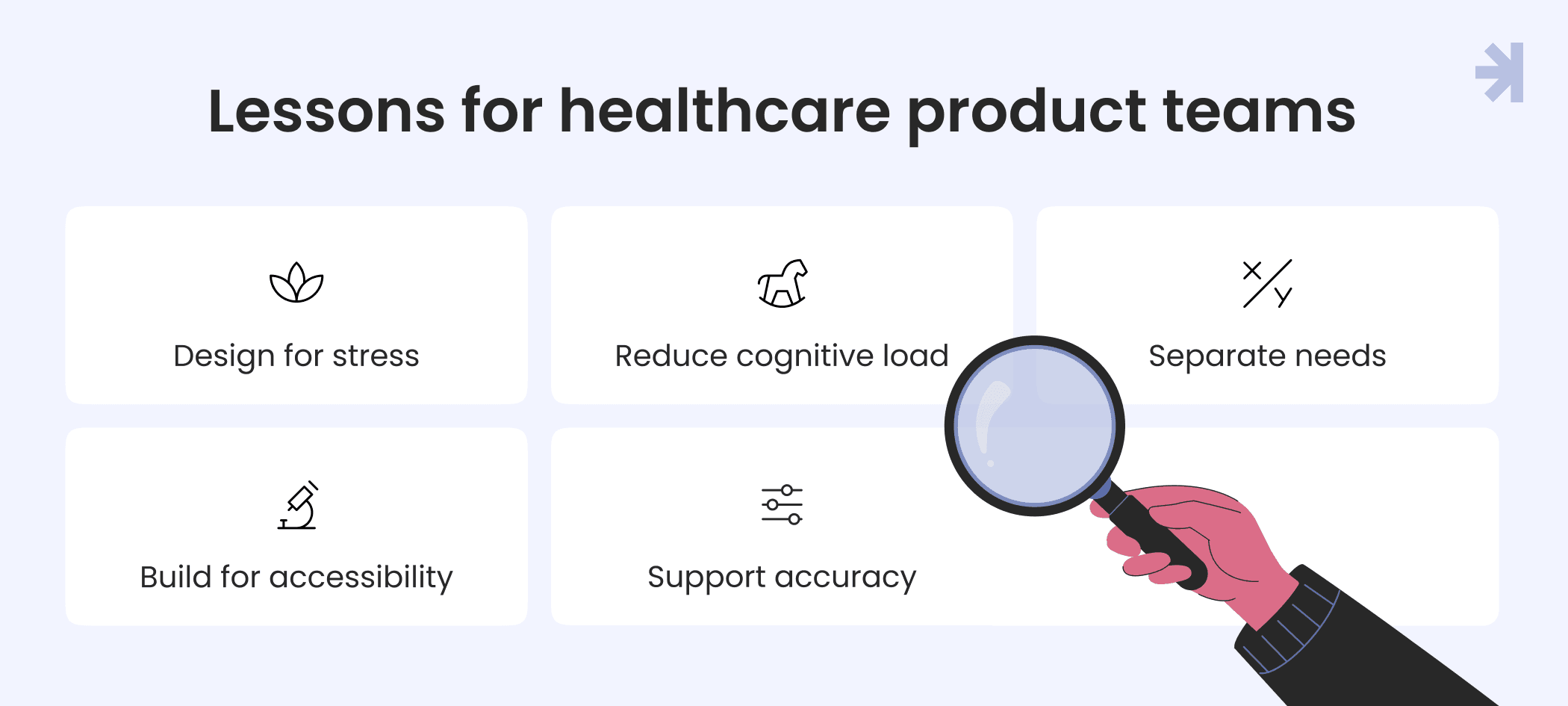
Healthcare UX design is never just about interfaces. It connects patients, clinicians, and administrative staff – all with different needs, pressure levels, and expectations. Good UX design directly impacts real outcomes, including patient outcomes and overall user experience.
In healthcare, every detail matters. Systems operate in high-stakes environments where safety, trust, and data security are critical. That’s why healthcare UX must follow strict regulations and design for clarity from the start.
Key lessons from this project:
- Design for stress: users in healthcare are often anxious or time-pressed
- Reduce cognitive load: simplify flows and prioritize clear structure
- Separate needs: patient portals and clinical tools require different UX logic
- Build for accessibility: inclusivity is essential across all healthcare systems
- Support accuracy: small UX errors can affect real patient care
Modern healthcare continues to evolve fast, especially after the rise of telehealth services and digital healthcare solutions. At the same time, technologies like artificial intelligence, augmented reality, and virtual reality are changing expectations, but only work when they serve real user needs.
For every healthcare UX designer, the key takeaway is simple: in healthcare, UX is not decoration. It’s part of care delivery.
When to consider UX design services for your healthcare product
In healthcare, UX design is not just about improving screens. It directly shapes how patients, clinicians, and administrative staff interact with critical systems. In many cases, a well-designed healthcare UX design can even influence real-world outcomes, improving both safety and efficiency of care.
You should consider UX design services when your product starts to show gaps in how it supports real user experience across different touchpoints in the healthcare sector.
Key signals include:
- Your product serves multiple groups (patients, clinicians, admins) but the experience feels inconsistent across healthcare systems
- Users struggle in high-stress situations where design for stress and clarity are critical
- Complex flows increase cognitive load instead of simplifying access to care
- Accessibility and inclusivity requirements are not fully met, despite strict standards in healthcare
- There is growing risk around patient data, privacy, and compliance (HIPAA, GDPR)
- Provider-facing tools like EHR systems lack efficiency in clinical workflows
Modern healthcare products operate in high-stakes environments where even small UX issues can affect patient care. That’s why healthcare UX must prioritize safety, trust, and clarity, especially when users are anxious, in pain, or under pressure.
The need for strong UX has also increased after the COVID-19 pandemic, which accelerated demand for digital healthcare solutions, including telehealth services and patient-facing platforms like patient portals. As a result, expectations for seamless patient experience are significantly higher today.
You should also consider UX support when:
- Your system needs better information hierarchy to manage complex medical data
- You are introducing new features that involve artificial intelligence or personalization
- You are scaling across healthcare settings with different user needs
- Your product is not meeting accessibility or WCAG compliance standards
In advanced healthcare technology, even emerging use cases like augmented reality and virtual reality in training, diagnostics, or mental health care increase UX complexity making structured UX design services even more important.
Ultimately, if your product operates in a regulated, high-stakes environment where mistakes matter, investing in healthcare UX is not optional. It’s a core part of delivering safe, reliable, and human-centered care.
Improve patient engagement with MagicFlux
In healthcare, every interaction matters. A well-designed healthcare UX design can improve patient engagement, reduce friction in care journeys, and directly support better patient experience and outcomes.
At MagicFlux, we design for complex healthcare systems where real user needs come first. Our UX designers and healthcare UX designers focus on turning complex workflows into clear, safe, and intuitive UX design solutions.
We help healthcare companies build digital products that work in real conditions while maintaining trust, clarity, and compliance.
If your product is struggling with engagement, complexity, or inconsistent user experience, it’s time to rethink the UX.

What is healthcare UX design?
Healthcare UX design is the practice of creating digital and physical touchpoints for the healthcare sector, including patients, clinicians, and administrative staff. It focuses on building safe, clear, and efficient experiences that support real user needs in medical environments.
Why is UX important in healthcare?
A strong user experience in healthcare can directly affect real-world outcomes. In many cases, good healthcare UX design improves patient engagement, reduces errors, and enhances the quality and efficiency of care, meaning it can literally support better patient outcomes.
What makes healthcare UX different from other industries?
Healthcare UX deals with deeply personal and sensitive experiences. It must consider strict legal, ethical, and privacy requirements while supporting users who are often stressed, in pain, or time-pressed. This is why healthcare UX prioritizes safety, trust, and clarity above everything else.
How does UX design reduce cognitive load in healthcare systems?
Effective UX design simplifies complex medical information using clear hierarchies, progressive disclosure, and intuitive layouts. This helps reduce cognitive load so users can focus on critical actions instead of navigating complexity in healthcare systems.
How is accessibility handled in healthcare UX?
Accessibility and inclusivity are essential in healthcare. Designers follow standards like WCAG to ensure systems are usable for people with impairments. Regular accessibility audits help identify issues that automated tools might miss, especially in complex clinical and administrative UX systems.
How does healthcare UX prevent medical errors?
Good healthcare UX design reduces risk by introducing real-time input validation, clear feedback, and safe interaction patterns. Features like large tap targets and structured workflows help prevent mistakes in high-stakes environments.